Categories
Uncategorized

Series 66 HDPE Maintenance

AVK Series 66 HDPE Gate Valves
Operation and Maintenance

Series 66 HDPE Gate Valve Repair

STEM/WEDGE, LOWER STEM SEAL COMPONENT REPAIR:

WARNING: To perform the following steps, be sure the Water Main Supply Line has been shut off, and that the pressure has been bled off! Also provide sufficient clearing around the valve so that no soil or debris may fall into it. 

1. Complete steps 1 through 4 in the UPPER STEM SEAL COMPONENT REPAIR section. 

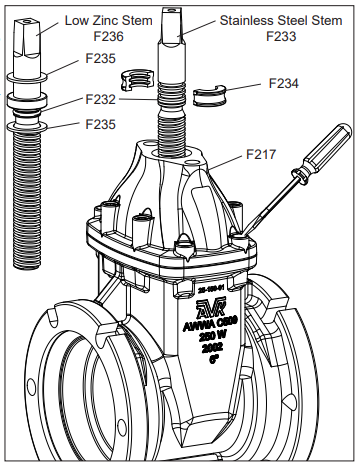
2. Turn the Stem (F333), in a closing direction until it disengages from the Wedge (F237), and remove from valve.

3. If applicable, for Low Zinc Stems, remove the Lower Anti Friction Washer (F235) from the recess in the bonnet (F217). For Stainless Steel Stems, the Stem Collar and Anti-Friction Washers are replaced by a two-piece Thrust Collar (F234). No Anti- Friction are necessary or present. The Lower Stem Seal O-ring (F232) should be present on the stem and in it’s own groove, located directly above the threads.

NOTE: On Stainless Steel Stems, the upper three grooves are for locating the Thrust Collar.

4. Inspect and replace any damaged parts.

NOTE: Use a food grade grease that contains no acetate or silicone on the new o-rings.

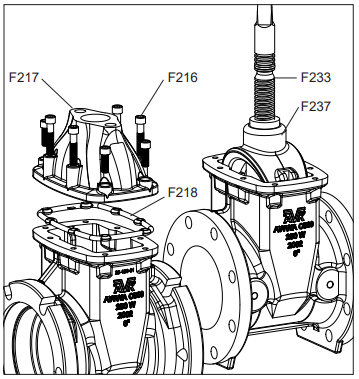
5. Using a small, flat bladed screwdriver, remove the hot melt glue that covers the Bonnet Bolts (F216).

6. Once the hot melt glue has been removed, use a 3/8”, or 10mm Allen wrench to remove the Bonnet Bolts (F216). Remove the Bonnet (F217) and Bonnet Gasket (F218) and set aside.

7. To remove the Wedge (F237) it is sometimes helpful to thread the Stem (F233) back into the wedge and use the stem as a handle or lever to extract the wedge. This is helpful with the larger sizes, (10” and 12”) valves.

8. Carefully inspect the interior of the valve body and remove any debris.

9. Inspect and replace any damaged parts and re-assemble in reverse order, torquing the Bonnet Bolts to 40 ft. lbs., in a diametrically opposed (180 degrees apart) pattern. 9. To replace the protective hot melt glue over the Bonnet Bolts, use any EPA approved caulk, or hot melt glue.

Categories
Uncategorized

Series 145 Maintenance

AVK Series 145 OS&Y Fire Protection Gate Valves
Operation and Maintenance

Handwheel Replacement

WARNING: To perform the following steps, be sure the Water
Main Supply Line has been shut off, and that the pressure has
been bled off!
NOTE: As most OS&Y valves are used in fire protection
applications, verify that any alarm systems have been
disabled prior to performing any maintenance or repairs.
1. Using a small, flat bladed screwdriver, remove the hot melt
glue that covers the Bonnet Bolts (F216).
( See Fig. 6A )
2. Once the hot melt glue has been removed, use 5/16″, or 8mm
Allen wrench to remove the 2½” valve Bonnet Bolts (F216),
and a 3/8”, or 10mm Allen wrench for valve sizes 3″- 8″.
3. Turn the remaining part of the Handwheel (F202) in the
closing direction. This will lift the Yoke/Bonnet (F263) head
assembly, allowing removal of the Upper Stem Nut (F201),
from the Stem Assembly (F215).
4. Remove the upper half of the Stem Nut (F201) from the
handwheel and place it in the “new Handwheel” (F202).
NOTE: The Stem Nut pair are keyed with different sized lugs.
Be sure to align the lugs in the correct location!
(See Fig. 6B)

5. Align the Upper Stem Nut (F201), with the Lower Stem Nut
(F205), And insure that there is full engagement of the lugs.
6. Carefully turn the Handwheel (F202) in the opening direction
until the Yoke/Bonnet (F263), is fully down and resting on the
Body (F219).
CAUTION: When lowering the head assembly back on the body,
take care to ensure that the Bonnet Gasket (F218), is not
damaged.
7. Install the Bonnet Bolts (F216), taking care to ensure they are
inserted through the Bonnet Gasket (F218), and tighten in a
diametrically opposed pattern.
8. To replace the protective hot melt glue over the Bonnet Bolts,
use any EPA approved caulk, or hot melt glue.
9. Repressurize the system. At this time, if there is a leak
around the Stem Seal O-ring area, be sure that the upper
Gland Follower Bolts (F261) are screwed down evenly into
the Bonnet/Yoke (F263). Tighten the nuts 1/4 turn each until
the leak stops

Series 145 OS&Y Fire Protection Gate Valve
Stem Seal O-Ring Replacement

WARNING: To perform the following steps, be sure the Water
Main Supply Line has been shut off, and that the pressure
has been bled off!
NOTE: Verify that any alarm systems have been disabled prior
to performing any maintenance or repairs.
1. Remove the two upper Gland Follower Bolts (F261)
and associated Washers (F262). Lift the Gland Follower
(F208) up expose the Stem Seal O-rings (F211). (See Fig. 7A)
2. Use a small screwdriver or probe to access the three Stem
Seal O-rings (F211).
NOTE: These O-rings are split-type o-rings. When replacing
them, insure that the splits DO NOT align. Rotate the
splits at approximately 30 degree intervals. Use a light
coat of FDA approved, food grade grease for lubrication.
(See Fig. 7B)
3. Reverse steps 2 and 3 for re-assembly.
CAUTION: Do not over tighten the upper pair of Gland Follower
Bolts (F261). Tighten the bolts evenly so the Gland Follower
applies even and level pressure on the O-rings. If the Gland
Follower is assembled at an angle, leaks may occur.
4. Repressurize the system. At this time, if there is a leak
around the Gland Follower (F208) be sure that Gland Follower
Bolts (F261) are screwed down evenly on the Gland Follower
(F208). Tighten the bolts 1/4 turn each until the
leak stops.

Series 145 OS&Y Fire Protection Gate Valve
Supervisory Switch Installation

1. AVK Series 145 OS&Y valves have a pre-tapped, 1/2″ NPT
threaded hole in the Yoke/Bonnet (F263), for mounting a
Supervisory Switch. (See Fig. 8A)
2. With the valve in the fully open position, there is a stem groove
that allows the switch to indicate the open position.
3. Refer to the switch manufacturer’s instructions for correct
switch installation.

Categories
Uncategorized

Series 03/25 Maintenance

AVK Series 03/25 Gate Valves
Operation and Maintenance

AVK Series 03/25 Gate Valves
Upper Stem Seal Component Repair

CAUTION: With the valve in the fully “OPEN” position, the
following procedures can be performed under full working
pressure, with no need to shut down the system.
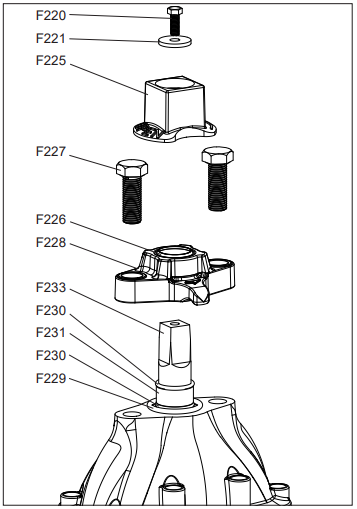
1. Remove the Wrench Nut/ Handwheel Bolt (F220) and
Wrench Nut/Handwheel Washer (F221) using a 1/2”, (13mm)
wrench, for 2 1/2” to 4” valve sizes, and 11/16”, (17mm)
wrench for 6” to 12” valve sizes. Remove the Wrench Nut
(F225) or NRS Handwheel (F222). (See Fig.4)
2. Remove the two Gland Flange Bolts (F227) using a 15/16″ or
24mm wrench for valve sizes 2.5″-4″, or a 1 1/4″ or 30mm
wrench for valve sizes 6″-12″.
3. Remove the Gland Flange (F228) with Wiper Ring (F226)
attached.
NOTE: The Wiper Ring (F226) is a “Factory Installed” press fit
and therefore must be reordered as an assembly along
with the Gland Flange (F228).
4. When performing step 3, verify the location of the Upper
Stem Seal O-rings, quantity 2, (F230) and the Stem Seal
Bushing (F231). They may be located on the Stem (F233),
(See Fig. 4A), or in the counterbore of the Gland Flange
(F228), (See Fig. 4B).
5. There is a groove in the bottom of the Gland Flange (F228),
for the Gland O-ring (F229). (See Fig. 4B)
6. Inspect and replace any damaged parts. Use a food grade
grease that contains no acetate or silicone, on the o-rings.
Re-assemble in reverse order.

Series 03/25 Gate Valve
Stem/Wedge Lower Stem Seal Component Repair

WARNING: To perform the following steps, be sure the Water
Main Supply Line has been shut off, and that the pressure has
been bled off! Also provide sufficient clearing around the valve
so that no soil or debris may fall into it.
1. Complete steps 1 through 4 in the UPPER STEM SEAL
COMPONENT REPAIR section.
2. Turn the Stem (F333), in a closing direction until it
disengages from the Wedge (F237), and remove from valve.
3. If applicable, for Low Zinc Stems, remove the Lower Anti-
Friction Washer (F235) from the recess in the bonnet (F217).
For Stainless Steel Stems, the Stem Collar and Anti-Friction
Washers are replaced by a two-piece Thrust Collar (F234).
No Anti- Friction are necessary or present. The Lower Stem
Seal O-ring (F232) should be present on the stem and in it’s
own groove, located directly above the threads.
NOTE: On Stainless Steel Stems, the upper three grooves are
for locating the Thrust Collar.

4. Inspect and replace any damaged parts.
NOTE: Use a food grade grease that contains no acetate or
silicone on the new o-rings.
5. Using a small, flat bladed screwdriver, remove the hot melt
glue that covers the Bonnet Bolts (F216).
6. Once the hot melt glue has been removed, use a 3/8”, or
10mm Allen wrench to remove the Bonnet Bolts (F216).
Remove the Bonnet (F217) and Bonnet Gasket (F218) and
set aside.
7. To remove the Wedge (F237) it is sometimes helpful to
thread the Stem (F233) back into the wedge and use the
stem as a handle or lever to extract the wedge. This is
helpful with the larger sizes, (10” and 12”) valves.
8. Carefully inspect the interior of the valve body and remove
any debris.
9. Inspect and replace any damaged parts and re-assemble in
reverse order, torquing the Bonnet Bolts to 40 ft. lbs., in a
diametrically opposed (180 degrees apart) pattern.
9. To replace the protective hot melt glue over the Bonnet Bolts,
use any EPA approved caulk, or hot melt glue